






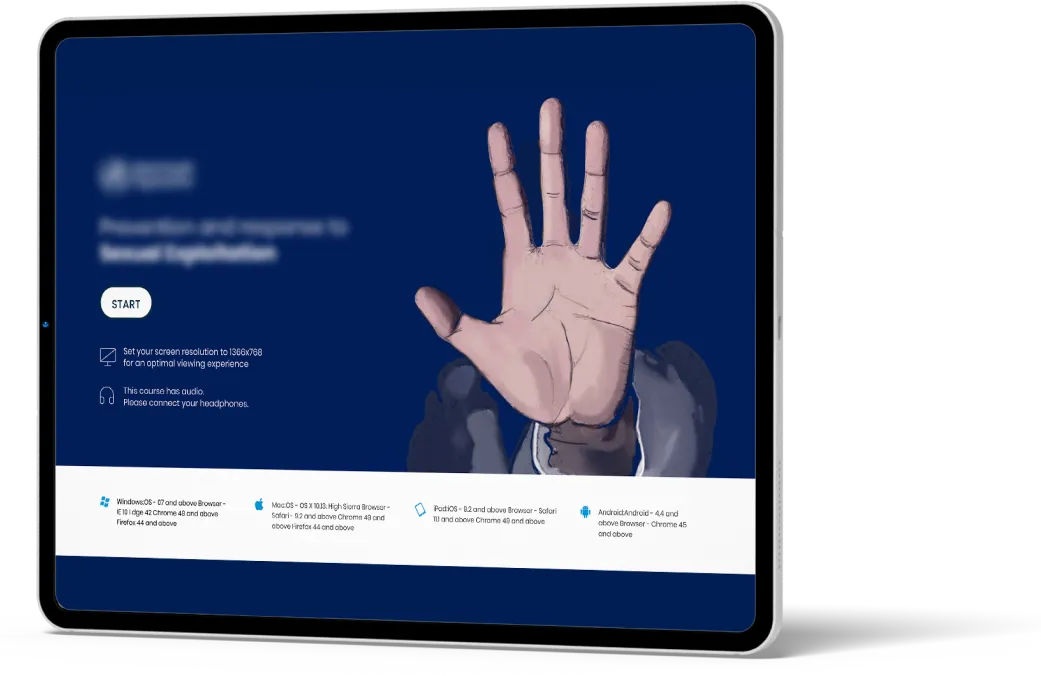
Designing aGamified Prevention & Responseto Sexual Misconduct Programme
Project Snapshot
| Industry | Global Public Health & Institutional Governance |
| Geography | Global Workforce Deployment |
| Audience | Employees Across Headquarters and Regional Offices |
| Delivery Format | Articulate Storyline (SCORM-Compatible) |
| Modules Delivered | 1 Comprehensive Gamified Compliance Module |
| Total Estimated Seat Time | 45–60 Minutes |
| Languages: | English (Primary) | French (Post-Approval Translation) |
| Engagement Model: | Subcontracted Delivery via Strategic Partner |
| Responsiveness: | Mandatory for All Employees |
Impact at a Glance
5 staged behavioural scenarios
Gamified pathway progression with accountability badges
Embedded reporting and helpline visibility
Custom stylised character illustration treatment
Integrated “Ask the Expert” intervention layer
Contextual policy excerpt integration per scenario
Certificate of Completion issued upon successful progression
Voiceover-integrated immersive storytelling
Multilingual rollout (English → French)
Global SCORM-based LMS deployment
The Strategic Context
A strategic partner engaged Qquench to transform a foundational storyboard into a fully realised, gamified compliance training experience.
The objective was to deliver a mandatory Prevention and Response to Sexual Misconduct programme that would:
Strengthen ethical workplace culture
Encourage bystander accountability
Improve situational decision-making
Standardise policy interpretation across a global workforce

While a base storyboard provided structural direction, Qquench led the experience architecture, visual treatment, gamification logic, interaction refinement, and full development execution.
This was designed not as passive policy awareness, but as behavioural reinforcement training.
Key Challenges & Constraints
1. Behavioural
Sensitivity
The subject matter required careful emotional balance across diverse cultural contexts.
2. Storyboard
Elevation
The initial storyboard required expansion into structured interaction logic and decision-based progression.
3. High Production
Visual Effort
Stylised character illustration and contextual scene composition were production-intensive.
4. Institutional
Policy Integrity
Policy accuracy had to be preserved without overwhelming learners with full-length documentation.
5. Global Compliance Governance
The module required consistent rollout across headquarters and regional offices.

Our Strategic Approach
Instructional Governance
1.
Storyboard Refinement
12.
Composed realistic environments (office settings, external meetings, digital exchanges)
2.
Clarified behavioural outcomes with partner
13.
Integrated professional voiceover narration
3.
Strengthened scenario tension and realism
14.
Implemented star-based scoring and badge logic
4.
Structured five milestone behavioural stages
15.
Policy Integration Strategy
5.
Gamification Architecture
16.
Extracted and cropped relevant policy excerpts per Knowledge Check
6.
Designed visible progression pathway
17.
Embedded contextual policy references within scenarios
7.
Defined scoring logic (correct vs incorrect responses)
18.
Made full policy and reporting channels accessible via Resources tab
8.
Mapped accountability badges to behavioural choices
19.
Localization & Deployment
9.
Experience & Visual Design Execution
20.
English approval followed by French translation
10.
Built in Articulate Storyline (SCORM-compatible)
21.
Packaged for global LMS distribution
11.
Developed stylised, sketch-inspired characters aligned to storyboard personas
Experience Design Innovation
Stylised Character-Driven Storytelling
Characters were transformed into sketch-based stylised visuals to ensure:
- Cultural neutrality
- Emotional relatability
- Visual consistency
- Non-identifiable representation
Each scene was composed to reflect realistic workplace contexts
Accountability Badge & Scoring System
- Correct responses earned stars
- Incorrect responses triggered corrective feedback
- Accountability badges reflected behavioural performance
Gamification reinforced ownership and responsibility rather than competition.
Contextual Policy Integration
Instead of directing learners to full-length documents, relevant policy excerpts were:
- Carefully cropped
- Contextually embedded within each Knowledge Check
- Simplified for immediate comprehension
The complete policy and official reporting channels remained accessible in the Resources tab.
This approach reduced cognitive overload while maintaining institutional integrity.
Completion Certification
Upon successful completion of all five stages, learners received a “PRS Champion” Certificate of Completion.
The certificate:
- Reflected badges earned
- Reinforced behavioural accountability
- Supported institutional compliance documentation
- Enabled printable tracking for audit purposes
Five-Stage Behavioural Pathway
Learners progressed through five milestone scenarios:
- The New Office
- The First Incident
- The Bystander’s Dilemma
- The Anonymous Complaint
- Support and Safety – A Positive Outcome
Each stage included:
- Conversational build-up
- Context-driven workplace tension
- Decision-based Knowledge Check
- Points awarded based on behavioural accuracy
Progress was visibly mapped through a pathway interface.
Expert Intervention Layer
An “Ask the Expert” feature was integrated within critical moments.
A stylised expert character — visually aligned with the module aesthetic — provided:
- Policy-backed clarification
- Bystander responsibility guidance
- Reinforcement of reporting obligations
This reduced ambiguity while preserving immersion.
Reporting & Helpline Visibility
The module highlighted official reporting channels and investigation contacts within scenario discussions.
This ensured learners understood:
- Where to report incidents
- Their obligations as bystanders
- Protection against retaliation
Training moved beyond awareness into actionable clarity.
Estimated Learning Metrics
(Based on Comparable Global Health Digital Deployments)
32–45% INCREASE IN ACCURACY
Increase in correct scenario-based responses driving behavioural decision accuracy improvement
85–95% COMPLETION
RATE
Completion rate benchmarks in gamified mandatory compliance programmes
28–38% STRONGER RETENTION
Stronger behavioural recall compared to static policy review, reflecting retention improvement
30–40% INCREASE IN CONFIDENCE
Increase in self-reported readiness to respond appropriately, strengthening confidence in policy application
Operational Execution Timeline
Phase 01
Storyboard Clarification & Behavioural Mapping
Phase 02
Character Design &
Scene Composition
Phase 03
Storyline Development & Gamification Logic
Phase 04
Voiceover
Integration & QA
Phase 05
English Approval → French Localization → LMS Deployment
Character treatment and contextual illustration represented the most production-intensive phase.
Impact Beyond Training
Strengthened Ethical Culture
Interactive scenarios encouraged reflective behavioural learning.
Interactive scenarios encouraged reflective behavioural learning
Clear visibility of reporting channels reduced hesitation in escalation.
Institutional Accountability Documentation
Certificate issuance supported audit-readiness and compliance tracking.
Global Cultural Consistency
Multilingual rollout strengthened policy alignment across regions.

Key Takeaways
Behaviour Must Be Practised, Not Acknowledged
Scenario-driven decision points moved learners beyond policy awareness into behavioural accountability.
Gamification Can Strengthen Compliance Discipline
Structured scoring and badge progression reinforced seriousness without trivialising misconduct prevention.
Contextual Policy Integration Reduces Overload
Embedding relevant excerpts within scenarios preserved accuracy while improving clarity and focus.
Expert Guidance Builds Decision Confidence
The integrated “Ask the Expert” layer reduced ambiguity and reinforced institutional standards.
Cultural Neutrality Enhances Global Deployment
Stylised character design ensured emotional relatability without cultural bias.
Certification Supports Governance Oversight
Structured completion tracking strengthened audit readiness and institutional compliance documentation.
FAQS
Q1. Was this delivered directly to the institution?
The project was executed through a strategic partner who provided the foundational storyboard. Qquench led digital design, gamification architecture, visual treatment, and development execution.
Q2. Was this training mandatory?
Yes. The module was deployed as mandatory training across global offices.
Q3. Did the module include policy guidance?
Yes. Contextual policy excerpts were embedded per scenario, with full policy access available via the Resources tab.
Q4. Were official reporting channels included?
Yes. Investigation contacts and reporting mechanisms were highlighted within scenarios and resources.
Q5. Was certification provided?
Yes. Learners received a PRS Champion Certificate of Completion upon successful progression.
Q6. Was the module multilingual?
Yes. The programme was translated into French following English approval.
Q7. Was it LMS-compatible?
Yes. The module was packaged as SCORM for global LMS integration.
Through this programme, Qquench demonstrated how mandatory compliance training can evolve beyond policy dissemination into immersive, behaviour-driven learning. By integrating gamified progression, contextual policy guidance, expert intervention, and certification-based accountability, the module strengthened institutional governance while reinforcing ethical responsibility across a global workforce.