






Designing astrategic Homepage Conceptfor a Global Trade Institution
Project Snapshot
| client type | Global Intergovernmental Organisation |
| Project Nature | RFP Submission |
| Scope | Sample Homepage Design Concept (Partial Website Prototype) |
| Format | High-Fidelity UI/UX Design |
| Objective | Demonstrate modernised digital direction aligned with institutional credibility |
Impact at a Glance
Modernised homepage visual direction
Clear content hierarchy within a dense institutional ecosystem
Strong global positioning through visual storytelling
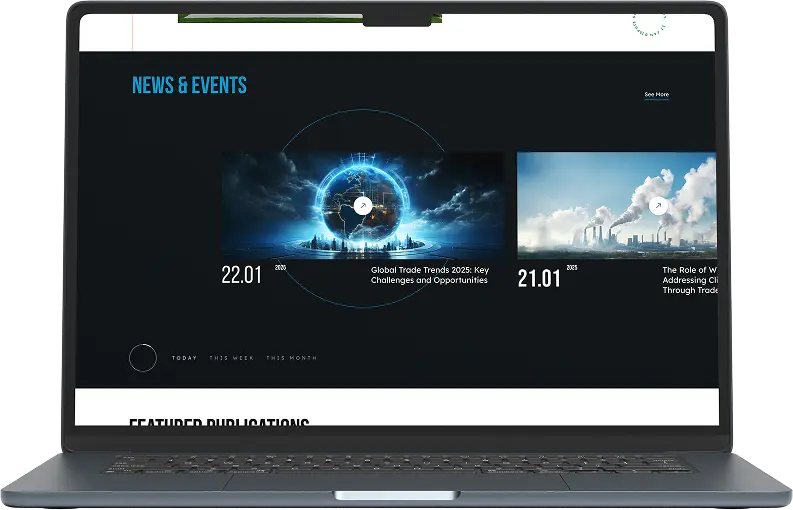
Structured News, Events, and Publications preview blocks
Institutional tone preserved with contemporary design language
The Strategic Context
Large intergovernmental organisations manage:
Their digital presence must balance:
Authority
Clarity
Accessibility
Visual modernity

The objective of this prototype was not to redesign the entire website — but to demonstrate how the homepage experience could evolve into a cleaner, more structured, and more strategically layered interface.
Key Challenges & Constraints
Institutional Seriousness
The design had to maintain diplomatic gravity and credibility while introducing a refreshed interface.
Content Density
Even within a single homepage, the layout needed to accommodate:
- Featured topics
- Meetings & Events
- News
- Publications
Without visual clutter.
Proposal-Stage Scope
As this was part of an RFP, the concept needed to clearly communicate capability and direction — within a limited sample scope.

Strategic Approach
Visual Authority with Structured Hierarchy
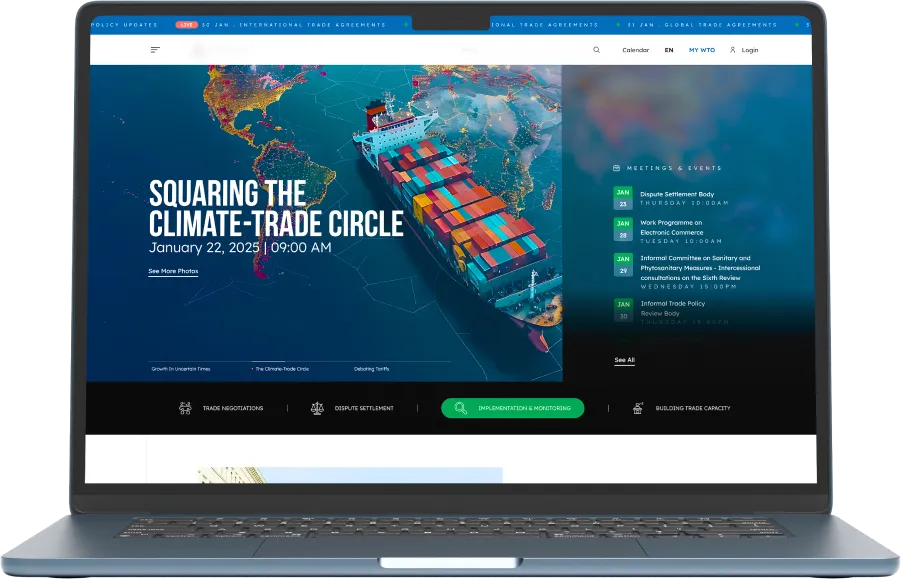
The homepage concept introduced:
- A strong hero section with global thematic relevance
- Clear typographic hierarchy
- Section-based content segmentation
- Card-style previews for news and publications
- Balanced dark–light contrast to improve readability
The design emphasised clarity and composure rather than visual experimentation.
Institutional Storytelling Through Layout
The hero banner positioned high-impact topics prominently, reinforcing global relevance.
Below it, content blocks were structured to guide users from:
Strategic theme → Events → News → Publications
Creating a logical scanning flow.
Clean Content Previews
Instead of overwhelming users with dense text, the design used:
- Curated preview cards
- Strong imagery
- Clear dates and titles
To improve discoverability while maintaining formal tone.
Experience Design Strengths
Governance-Aware
Design
The layout respects the nature of global institutional communication — prioritising clarity and trust.
Modern Without Being Trend-Driven
The interface feels updated but not stylistically excessive — important for policy-led organisations.
Structured Visual Breathing Space
Improved spacing and alignment reduced cognitive load within a content-heavy environment.
Estimated UX Impact
(Based on Comparable Institutional Redesign Benchmarks)

Improved homepage scanability by 25–35%
Increased visibility of time-sensitive events
Stronger engagement with featured publications
Reduced visual fatigue in high-density content environments
Operational Timeline
phase 01
Homepage Audit & Visual Direction Definition
phase 02
High-Fidelity Design Prototype
phase 03
RFP Presentation & Strategic Justification
As a POC, emphasis was placed on governance fidelity and behavioural realism.
Impact Beyond Training
Demonstrated Strategic Web Capability
The prototype showed how a global institution’s homepage could evolve without compromising authority.
Clear Direction for Full-Scale Redesign
While limited in scope, the concept established a strong visual and structural foundation.
Elevated Proposal Differentiation
The design strengthened the overall proposal by showcasing execution capability — not just strategy.
Key Takeaways
Institutional web design must prioritise clarity over decoration.
Homepage structure determines user trust and engagement.
Modernisation can coexist with diplomatic seriousness.
Technology alone cannot replace in-person nuance — structured instructional design must lead.
FAQS
Q1. Was this a full website redesign?
No. This was a homepage concept developed as part of an RFP submission.
Q2. Was it implemented?
No. It was a high-fidelity prototype demonstrating visual and structural direction.
Q3. Did it include full IA restructuring?
No. The scope focused on homepage experience design.
Through this engagement, Qquench demonstrated how even a single strategic homepage concept can communicate institutional credibility, improve clarity, and elevate digital presence for global organisations.