






Designing anAI Patient Simulationfor Real-Time Clinical Decision-Making
Project Snapshot
| Industry | Healthcare |
| Audience | Healthcare Providers |
| Delivery Format | Storyline + HTML Simulation |
| Delivery Model | Guided Learning + AI Interaction |
| Project Type | Internal Concept / Proof of Concept |
| Interactivity Level | High (Simulation-based) |
| Output | AI-enabled patient interaction environment |
| project duration | 1 Month |
Impact at a Glance
AI-driven patient simulation enabling real-time conversational learning
Dual-layer learning design (guided + open simulation)
Guardrail-controlled AI behaviour for safe clinical interaction
Progressive diagnostic journey from symptoms to treatment
High-engagement, decision-led learning experience.
The Strategic Context
Healthcare training often relies on static case studies or linear modules, which do not fully replicate the complexity of real patient interactions.
This concept was designed to explore how AI could:
Enable behaviour-driven clinical decision-making
Support step-by-step clinical reasoning
Simulate decision-making under uncertainty
Move beyond passive learning into applied practice
Bridge the gap between knowledge and real-world clinical behaviour
The objective was to create a safe, controlled simulation environment where learners could interact with a virtual patient and progress through diagnosis and treatment decisions.
Traditional training often improves knowledge, but does not consistently translate into behaviour change in real clinical scenarios.

Key Challenges & Constraints
1. AI Hallucination Risk
Ensuring the AI did not generate medically incorrect or unsafe responses.
2. Multi-Step Clinical Workflow Complexity
Designing a structured yet flexible flow from initial questioning to diagnosis and treatment.
3. Lack of SME Clarity
Limited structured input required iterative refinement of scenarios and responses.
4. Real-Time Interaction Requirements
The AI needed to respond dynamically while maintaining clinical relevance.
Our Strategic Approach
The solution was designed as a dual-layer learning experience:
Guided Learning Layer (Storyline)
A structured pathway was created to:
- Introduce the scenario
- Guide learners through expected clinical steps
- Establish foundational understanding before simulation
Iterative AI Conditioning
The AI model was continuously refined through:
- Scenario testing across multiple interaction paths
- Response validation under different user inputs
- Progressive strengthening of guardrails
This ensured consistency, safety, and contextual relevance.
AI Simulation Layer (HTML Environment)
A separate simulation environment was built where:
- The learner takes on the role of a healthcare provider
- The AI acts as a patient responding in real-time
- The interaction progresses from:
- Basic questioning
- Symptom identification
- Diagnostic reasoning
- Treatment decision
Experience Design Innovation
AI-Powered
Patient Simulation
A conversational AI system designed to behave like a patient, enabling natural interaction.
Progressive
Clinical Journey
Design
Learners move step-by-step from:
Initial consultation → Investigation → Diagnosis → Treatment
Dual Learning Flow Architecture
Combination of guided instruction and open-ended simulation for layered learning.
Behaviour-Led
Simulation Design
The simulation was structured to guide users through realistic decision pathways, reinforcing correct clinical behaviours through interaction rather than instruction.
Guardrailed AI
Behaviour System
Strict constraints applied to:
- Prevent out-of-scope responses
- Avoid personal or irrelevant questions
- Maintain clinical tone and focus
- Restrict answer leakage
Real-Time Response
Engine
Immediate AI responses create a dynamic, immersive experience.
Structured Assessment Architecture
Formal assessment was not included in this concept.
The simulation itself functioned as a practice-based decision environment, allowing learners to progress through clinical reasoning steps.
Estimated Learning Metrics
(Based on Comparable Simulation-Based Learning Deployments)

30–45%
Decision-Making Confidence Improvement
85–95%
Engagement Rate Benchmarks
28–38%
Clinical Reasoning Retention
80–90%
Simulation Interaction Completion
Stakeholder Feedback
01
AI interaction flow was positively received
02
Simulation approach appreciated for realism
03
Approved without major structural changes
Operational
Execution Feedback
Phase 01
Concept Design & Flow Structuring
Phase 02
Storyboard Development & Simulation Logic
Phase 03
AI Integration & Guardrail Definition
Phase 04
Testing, Iteration &
Refinement
AI response behaviour and guardrail accuracy were validated continuously throughout development.
Impact Beyond Training
Supports Behavioural Consistency
Helps standardise how healthcare providers approach patient interactions and decision-making.
Enables Safe Clinical Practice Simulation
Allows learners to practise decision-making without real-world risk.
Scalable AI-Based Learning Model
Demonstrates potential for replication across multiple healthcare scenarios.
Bridges Gap Between Theory and Practice
Moves beyond knowledge into applied clinical reasoning.
Foundation for AI-Assisted Training Systems
Establishes a framework for future intelligent learning environments.

Key Takeaways
AI Enables Applied Learning at Scale
Simulation-based interaction allows learners to practise decisions, not just recall information.
Guardrails Are Critical in AI Learning Systems
Controlled AI behaviour ensures safety, relevance, and trust.
Behaviour Change Requires Practice, Not Just Content
Simulation environments enable learners to apply knowledge in context, leading to stronger behavioural adoption.
Dual-Layer Learning Strengthens Understanding
Guided learning prepares users before a simulation-based application.
Simulation Drives Deeper
EngagementInteractive environments significantly improve learner involvement.
Why This Matters
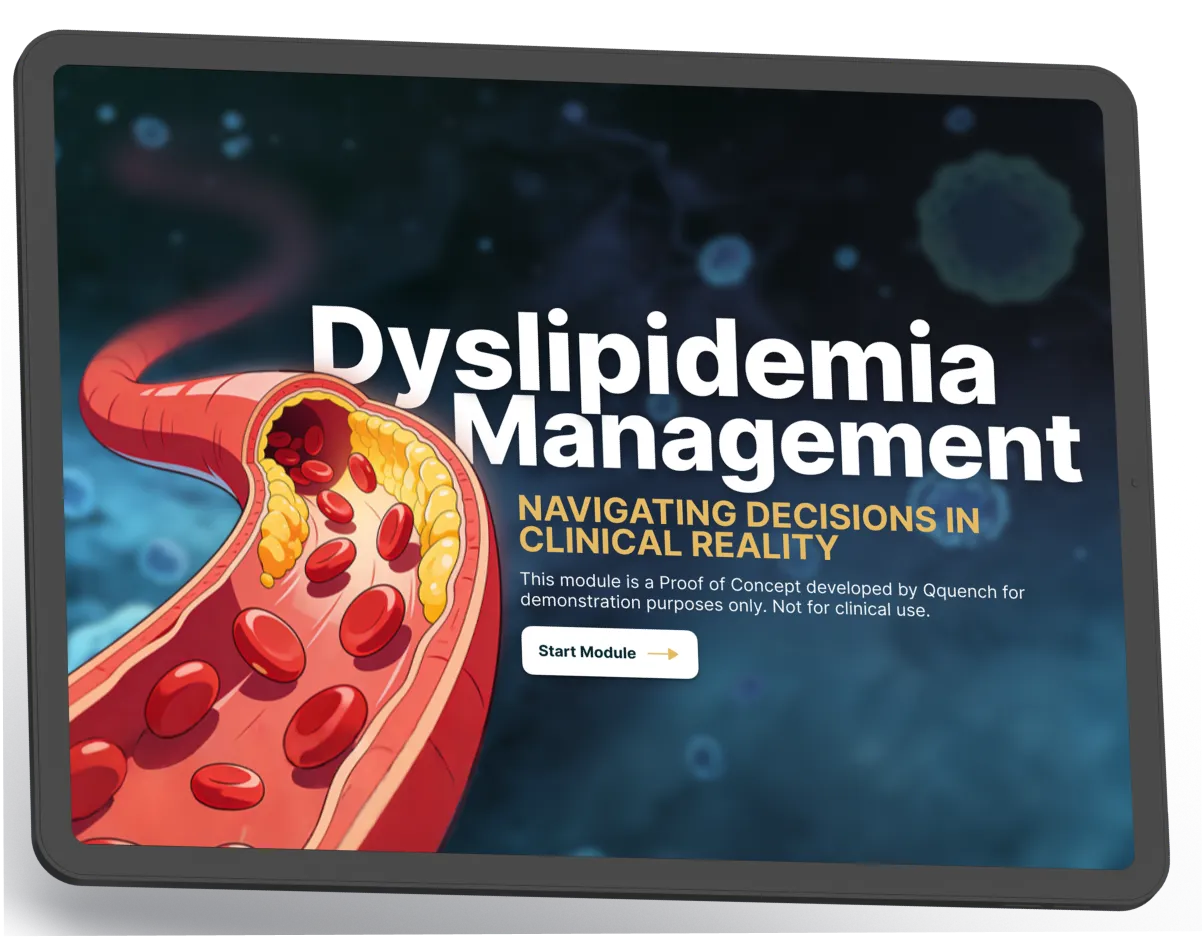
This Proof of Concept demonstrates how Qquench enables behaviour-driven clinical training through AI-powered simulation environments, allowing healthcare providers to practise decision-making in a safe, controlled, and scalable manner.
FAQS
Q1. Was this a full implementation?
No, this was an internal Proof of Concept developed to demonstrate the potential of AI-driven simulation learning.
Q2. Who was the target audience?
Healthcare providers involved in clinical decision-making.
Q3. Was this LMS-ready?
The guided layer was LMS-compatible, while the AI simulation was built as a standalone HTML environment.
Q4. Did it include assessment?
No formal assessment was included; the simulation itself functioned as a practice environment.
Q5. Was the AI fully autonomous?
No, it operated within defined guardrails to ensure safe and relevant responses.
Q6. Why is the one-month delivery notable?
The solution was designed, built, and approved in a single cycle despite significant technical logic complexity.
Through this concept, Qquench demonstrated how clinical training can evolve from structured instruction into interactive, AI-powered simulation experiences, where learners actively engage, make decisions, and build real-world readiness.