



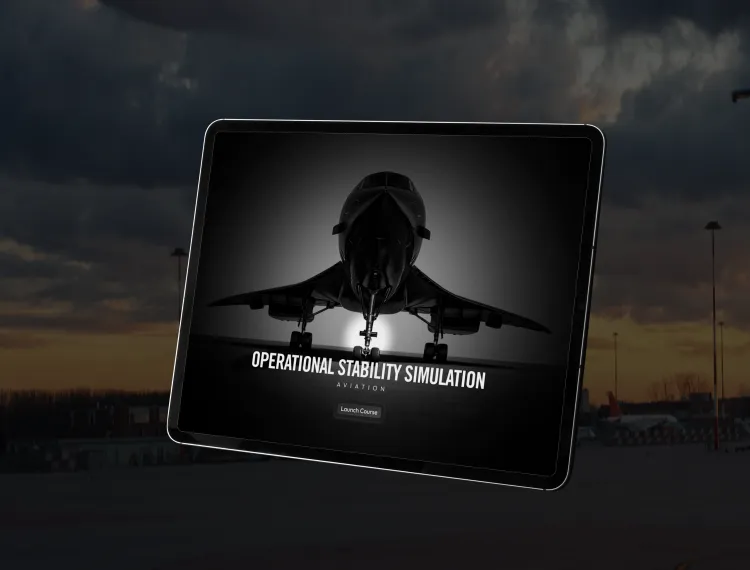



Simulator Training vs eLearning in Maritime and Aviation; Getting the Blend Right
Full-mission bridge simulators, STCW-approved training centres, and type-rating flight simulators represent the most expensive per-head training investment in the transport sector. eLearning can address a significant portion of the knowledge and procedure burden, reducing simulator hours and cost without reducing competency outcomes. The failure mode is not too much eLearning. It is eLearning used for…
1. The Blend Problem — Why Wrong Sequencing Wastes the Most Expensive Training Asset
Simulator time in maritime and aviation is expensive. A full-flight simulator session costs thousands per crew member. A full-mission bridge simulator for maritime training is comparable. Type rating simulators, ECDIS navigation simulators, and emergency response training centres all carry per-session costs that create significant pressure on training budgets.
eLearning appears to offer a straightforward cost solution. And it does; but only when the blend is designed correctly. The most common mistake is not overusing eLearning. It is using eLearning for components that require physical or simulator-based practice, and then either cutting the simulator time that those components require or delivering it after eLearning that did not adequately prepare crews for the transition.
30–40%
of a typical type rating programme’s learning hours can be delivered via eLearning — systems theory, emergency procedures knowledge, regulatory frameworks — before simulator hours are needed
STCW 2026
amendments now in force; distance learning provisions exist for knowledge components of approved courses, but practical assessment remains face-to-face or simulator-required
Crew cost
reduction of 20–30% achievable through correctly blended pre-simulator eLearning; without reducing the competency outcome, by maximising simulator time efficiency
Key Distinction
Simulator time is expensive because it develops skills that require a high-fidelity environment, emergency response coordination, multi-crew communication under pressure, equipment handling in abnormal conditions. eLearning is cost-effective because it delivers knowledge efficiently; procedures, regulations, systems theory, decision frameworks. The blend is correct when eLearning prepares crews to maximise simulator time, not when it attempts to replace what the simulator must do.
2. What eLearning Can Deliver in Maritime and Aviation
The knowledge and procedure components of maritime and aviation training represent a significant proportion of total learning hours in any regulatory programme. These components are well-suited to eLearning delivery, they do not require a physical environment, they can be completed asynchronously on crew rotation schedules, and they can be updated efficiently when regulations or procedures change.
- Regulatory and procedural knowledge. STCW regulations, SOLAS requirements, MARPOL provisions for maritime. EASA regulations, JAR-OPS requirements, airspace rules for aviation. These are text-heavy knowledge domains that eLearning delivers efficiently with excellent retention when scenario-based retrieval practice is built into the design.
- System and equipment theory. Bridge navigation system operation, GMDSS theory, ECDIS chart management principles for maritime. Aircraft systems; hydraulic, electrical, pneumatic, avionics, at the theoretical level for aviation. Understanding how systems work and interact is a knowledge objective that eLearning handles well as a prerequisite to simulator system drills.
- Emergency procedure decision frameworks. The cognitive component of emergency response, recognising the abnormal condition, identifying the appropriate procedure, and sequencing the initial actions; can be developed through eLearning scenario practice. The physical execution of those procedures under time pressure requires the simulator. eLearning builds the cognitive framework; the simulator builds the skill.
- Pre-simulator familiarisation and briefing. When crews arrive at a simulator session having already worked through the aircraft or vessel systems in eLearning, simulator time can be used for integration, drills, and assessment rather than for the familiarisation that eLearning should have delivered. Well-designed pre-simulator eLearning reduces the familiarisation component of simulator sessions by a measurable proportion; which directly reduces the simulator hours required.
3. What eLearning Cannot Substitute — The Simulator’s Non-Negotiable Role
The simulator exists because certain competencies cannot be developed without it. The physical and cognitive demands of operating complex equipment under emergency conditions, the coordination required for multi-crew operations in abnormal scenarios, and the judgement needed to manage conflicting priorities in real time; these are not knowledge objectives. They are performance capabilities that require practice in a high-fidelity environment.
| Training Component | eLearning Appropriate? | Simulator/ATC Required? | Rationale |
|---|---|---|---|
| Regulatory knowledge and procedures | Yes | No | Knowledge objective; efficient in eLearning with scenario-based retrieval |
| Equipment systems theory | Yes | No; unless interaction required | Knowledge objective; prerequisite for simulator systems drills |
| Emergency procedure decision framework | Partially; cognitive component | Yes; execution component | Cognitive framework in eLearning; physical execution in simulator |
| Multi-crew coordination under pressure | No | Yes | Requires real-time multi-person interaction in high-fidelity environment |
| Abnormal and emergency drills | No | Yes | Psychomotor skill under pressure; cannot be simulated adequately in eLearning |
| Full-flight manoeuvres and ship handling | No | Yes | Physical control skill; cannot be developed without the simulator environment |
“The crews that get the most from simulator time are the ones who arrive having already mastered the knowledge components in eLearning. The simulator session is then entirely devoted to skills that require it, not to procedural content that eLearning could have delivered at a fraction of the cost.”
4. Designing the Blend — A Framework by Training Component
- Classify every training component by the capability type it develops. Knowledge objectives — facts, procedures, regulations, system theory — go to eLearning. Psychomotor and multi-crew coordination skills, emergency drills, ship handling, flight manoeuvres — go to simulator. Decision-making under pressure sits in both: the cognitive framework in eLearning, the physical execution in simulator. This classification is the design foundation.
- Sequence eLearning before simulator, not alongside it. The blend that produces maximum simulator time efficiency is the one where eLearning is completed before crews arrive at the training centre. Crews who complete eLearning modules on vessel systems, emergency procedures, and regulatory requirements before their simulator sessions arrive ready to drill rather than ready to learn. The simulator session becomes a competency development session, not an introduction session.
- Build retrieval practice into eLearning to maximise simulator readiness. eLearning for maritime and aviation training must include scenario-based retrieval practice; not just information delivery. Crews who have actively recalled and applied procedural knowledge in eLearning scenarios arrive at the simulator with better procedural memory and require fewer repetitions to reach drill proficiency.
- Design the assessment framework to cover both components. Regulatory assessment for knowledge components via eLearning. Performance assessment for simulator components via qualified assessors with standardised observation criteria. The competency record must evidence both; because the regulatory body and the operator both need to see that knowledge has been assessed and performance has been demonstrated.
In Summary
Maritime and aviation training cannot replace simulator time with eLearning, but it can use eLearning to make every simulator hour more effective. The key is knowing which components belong in digital learning, regulations, procedures, system theory, and decision frameworks, and which must remain in simulator or face-to-face practice.
The operators that will reduce training cost without weakening competency are those designing the blend carefully: using eLearning to prepare crews before simulator sessions, while preserving simulator time for emergency drills, multi-crew coordination, and high-pressure operational performance.
Qquench · 25+ Years · Maritime and Aviation Training · Blended Programme Design · Simulator Cost Optimisation · Regulatory Compliance · Global Transport
Qquench designs maritime and aviation blended training programmes that reduce simulator costs without reducing competency outcomes, by getting the classification of knowledge vs. skills components right before design begins.
We work with operators, flag state administrators, and training centres to design the eLearning components that maximise the value of every simulator hour.
Frequently Asked Questions
Q1
Can STCW-approved training be delivered via eLearning?
Some STCW knowledge and theory components can be delivered via eLearning under IMO-approved distance learning provisions. Practical and assessment components require face-to-face or approved simulator delivery. Any eLearning within an STCW programme must be part of a course formally approved by the flag state administration.
Q2
What is the correct use of eLearning in maritime and aviation training?
eLearning is most effective for regulations, system theory, navigation rules, and emergency procedure decision frameworks, components that prepare crews to maximise simulator time. Using eLearning to replace simulator time for psychomotor skills, emergency response practice, or multi-crew coordination is the incorrect use of the format.
Q3
How much of a type rating course can be delivered via eLearning?
Typically 30–40% of learning hours; aircraft systems, performance data, emergency procedure theory, and regulatory knowledge. The remaining 60–70% requires full-flight simulator time for systems integration, emergency drills, and flight manoeuvres that must be demonstrated to regulatory standard.
Q4
What are the cost benefits of correctly blending eLearning into maritime and aviation training?
The primary benefit is reducing simulator and approved training centre hours; the most expensive training components. Crews who arrive having completed eLearning knowledge components require fewer familiarisation simulator hours. Correctly designed blends typically reduce required simulator hours by 20–30% without reducing competency outcomes.
QS
Qquench Specialists
Maritime and Aviation Training Practice · Qquench
25+ years designing blended training programmes for maritime and aviation operators, combining regulatory eLearning efficiency with the simulator time that operational competency requires. We write from practice, not position papers.