






Clinical Training Simulators: Why Healthcare Can’t Afford to Train on Patients
Healthcare has accepted simulation for procedural skills for decades no one disputes that surgical trainees should practise on a manikin before operating on a person. The same principle applies to clinical consultation, diagnostic reasoning, and high-stakes patient conversations. AI simulation makes it practical at scale. The question for healthcare L&D leaders is not whether it…
1. The Asymmetry Healthcare Has Always Accepted
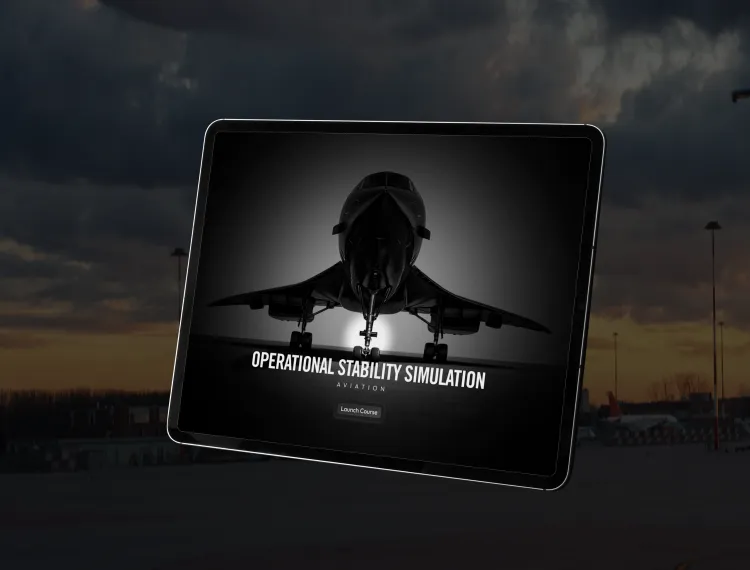
Commercial aviation established a principle that is now so embedded it is invisible: a pilot does not fly a passenger aircraft until they have demonstrated competency in a simulator. The simulator does not replace flight experience it precedes it, establishing the baseline of skill that makes live practice safe enough to begin. Healthcare accepted the same principle for procedural skills decades ago. Surgical residents practise on task trainers. Anaesthesiologists train on high fidelity manikins. Resuscitation teams run simulated codes. The logic is identical to aviation: some skills carry a cost of learning-by-doing that neither the patient nor the institution should bear.
The asymmetry is in what simulation covers. Procedural simulation is well established. Conversational and cognitive clinical simulation the skills required to take a history under patient distress, break difficult news, navigate a diagnostic reasoning process under uncertainty, or manage an aggressive patient encounter is not. In most clinical training programmes, those skills are still developed primarily through real patient contact, with real patients absorbing the cost of trainee inexperience.
This is not a values problem. It is a technology problem that until recently had no good solution. Standardised patients (actors) provided a partial answer valuable for structured clinical examinations and specific communication training but not scalable, not consistently available, and not calibrated to the specific incident patterns of a given clinical environment. AI simulation changes that equation.
Key Distinction
Procedural simulation trains a physical sequence. Conversational and cognitive clinical simulation trains a dynamic response to an unpredictable human which requires an AI counterpart, not a manikin. The technology that makes the second type of simulation viable at clinical scale is the same technology that makes effective sales simulators work: a system that responds to what the trainee actually says, not to what the designer anticipated they would say.
2. Where Simulation Currently Stops and Why
In most healthcare organisations, clinical simulation investment is concentrated in procedural skills training because that is where purpose built simulation technology has existed longest, and where the regulatory frameworks supporting simulation as a competency pathway are most mature. The investment in conversational and cognitive clinical skill simulation, where it exists at all, typically means standardised patient programmes that run periodically, are expensive per learner, cannot be accessed on demand, and produce inconsistent patient behaviour that varies with each actor engagement.
The practical result is that the clinical skills most directly implicated in consultation related incidents inadequate history taking, failure to communicate diagnostic uncertainty, poor management of patient distress, missed cues in a deteriorating patient conversation are the ones with the least structured pre competency simulation pathway. Trainees develop these skills through supervised clinical contact: valuable, but dependent on case mix, supervisor availability, and the willingness of real patients to accept an inexperienced trainee without knowing the full context of that inexperience.
This is the gap that AI clinical simulation addresses not by replacing clinical contact, but by ensuring that the trainee arrives at that contact with a level of conversational and cognitive preparation that makes the real encounter safer for both patient and clinician.
3. What AI Simulation Changes for Clinical Education
An AI clinical simulator allows the trainee to conduct a full patient consultation spoken or typed, in their own clinical language with a virtual patient whose responses are generated dynamically based on the trainee’s actual clinical behaviour. The patient can be distressed, evasive, confused, or confrontational. Their history can be complex and ambiguous. Their concerns can be psychosocial as well as physical. And crucially, they respond to what the trainee actually does not to what a script anticipated.
This produces a practice environment with three characteristics that no other format can replicate at scale. First, availability: the trainee can access a consultation simulation at any time, without scheduling an actor or a supervisor. Second, volume: the trainee can conduct the same consultation type many times, with variations, before the first real patient encounter of that type. Third, consistency: the clinical scenario is calibrated precisely to the competency being developed, without the natural variation of actor performance or supervisor interpretation.
Research on AI simulation in healthcare education confirms that allowing trainees to first apply diagnostic reasoning and consultation skills under simulated conditions leads to improved diagnostic accuracy, enhanced patient communication, and safer clinical decision making. The same research identifies the honest limitation: AI simulation and standardised patient simulation are not direct replacements. Each has contexts where it holds an advantage, and the strongest clinical education outcomes come from using both selectively.
396
Students in a 2024 multicenter RCT comparing AI virtual patient simulation to actor-based standardised patient training for clinical consultation skills (University of Nottingham)
95%
completion rate across both arms of the trial AI simulation produced equivalent engagement to actor-based formats
~950
AI and machine learning medical devices authorised by the US FDA as of mid-2024 clinical AI is not theoretical
70%
of healthcare organisations implementing AI training solutions, with simulation cited as a primary clinical competency pathway
“Healthcare has always known that some skills are too consequential to practise for the first time on a real patient. AI simulation extends the boundary of what can be practised safely before the first real encounter and the skills it reaches are the ones most closely linked to the consultation incidents that damage patients and institutions.”
4. What the Evidence Actually Shows
A 2024 multicenter randomised controlled trial at the University of Nottingham compared AI virtual patient simulation to actor based standardised patient training for clinical consultation skill development in 396 third year medical students. Both interventions used the same intended learning outcomes. The study found that AI simulation produced comparable development in clinical communication skills with the AI format offering significant advantages in accessibility, repeatability, and consistency of clinical scenario delivery. Actor based simulation retained advantages in scenarios requiring team-based communication and emotionally complex human interaction.
This finding is important for healthcare L&D decision-makers because it reframes the question from “is AI simulation as good as standardised patients” to “which clinical scenarios are best served by each format.” That is a design question, not a technology question. The answer depends on the specific competencies the organisation needs to develop and the incident patterns that make those competencies the priority.
The evidence also points to an important caution. AHRQ’s analysis of AI in patient safety contexts emphasises that the goal of any AI clinical tool including training simulation must be precisely aligned with the patient safety outcome it is designed to influence. A simulation designed for the wrong clinical competency, or calibrated to an unrealistic patient presentation, will produce confident trainees who are not prepared for the real clinical encounters that matter. Simulation design quality is as important in healthcare as in any other context and arguably more consequential.
Qquench Specialists · Clinical Simulation Design · Healthcare
Identify the clinical competency gap in your organisation where real patient training carries the highest risk and find out whether simulation can close it.
Qquench’s clinical simulation scoping process starts from incident data and competency evidence, not from a technology demonstration. If simulation is the right format, we design it for the specific clinical environment your trainees will enter.
5. The Qquench Approach: Starting from the Incident, Not the Curriculum
When Qquench scopes a clinical simulator engagement, the starting point is the organisation’s incident and near miss data specifically, the consultation-related incidents that recur in the clinical environment the simulator will serve. This is a different starting point from the clinical curriculum, from national competency frameworks, and from the scenarios that make the most interesting demonstrations. It is the starting point that produces a simulator aligned with the actual patient safety priorities of the organisation.
The design then follows from the specific clinical scenarios where trainee performance most directly affects patient outcomes. The AI patient is calibrated to present the specific challenges ambiguous history, emotional distress, language or cultural barriers, diagnostic complexity that characterise the real encounters the trainees will face. For Qquench’s healthcare clients across India, GCC, and Southeast Asia, this means cultural and linguistic calibration is a design requirement, not an afterthought. The patient a trainee in Mumbai or Dubai encounters does not behave like the patient in a generic Western clinical case library.
A large hospital group we worked with in the GCC had consistent near miss data in patient history taking for junior clinical staff, particularly in emergency presentations where communication barriers and time pressure combined to increase assessment error risk. A simulator calibrated to that specific scenario type with AI patients presenting in regional language patterns, exhibiting the communication behaviours characteristic of the local patient population, and presenting the specific ambiguity patterns most correlated with the near misses produced measurable improvement in assessment accuracy in that patient group. The clinical curriculum did not change. The practice environment for the specific scenario type did.
Related Reading
In Summary
Healthcare has always accepted that some clinical skills carry a cost of real patient practice that should be minimised before competency is established. Procedural simulation addressed this for physical skills. AI simulation now addresses it for conversational and cognitive clinical skills the domain where most consultation related incidents originate. The evidence from controlled trials supports the format’s effectiveness. The design question that determines whether a simulator produces patient safety outcomes or impressive completion data is the same in healthcare as in any other context: what specific competency gap is it built for, and does the design start from the incidents that make that gap consequential?
Qquench Specialists · 25+ Years · Healthcare · GCC · India · Southeast Asia
Find out whether your highest-priority clinical competency gap has a simulation case before any technology decision is made.
Qquench’s clinical simulation scoping session examines your incident data and competency evidence, and produces a clear recommendation on whether simulation is the right investment and what it needs to be designed for.
Frequently Asked Questions
Q1
What clinical skills are best suited to AI simulation in healthcare?
AI simulation is most valuable for clinical skills where real patient practice before competency carries unacceptable risk and where the skill requires a dynamic, responsive interaction rather than a procedural sequence. This includes patient history taking, clinical consultation and communication, breaking bad news, managing a distressed or hostile patient, and diagnostic reasoning under ambiguity. Procedural skills are well served by existing manikin based simulation. Conversational and cognitive clinical skills are where AI simulation offers a capability no other format currently provides at scale.
Q2
How does AI virtual patient simulation compare to standardised patient simulation?
A 2024 multicenter RCT at the University of Nottingham found that AI virtual patient simulation produced comparable clinical communication skill development to actor-based standardised patient training, with advantages in accessibility, repeatability, and consistency. Standardised patients retain advantages in team based and emotionally complex scenarios. The strongest outcomes come from using each format where it has an advantage rather than treating them as direct replacements.
Q3
What is the business case for clinical simulation investment in a large healthcare organisation?
The business case starts from the cost of the skill gap. A measurable incident category tied to a specific clinical competency has a calculable average incident cost and frequency. A simulator designed to build that competency produces a case measured against incident reduction rather than training hours. Healthcare organisations that have made this calculation consistently find that simulation investment is recovered within one to two incident cycles for the targeted competency.
Q4
Does AI clinical simulation meet regulatory and accreditation requirements?
AI simulation is increasingly recognised in medical education accreditation frameworks as a valid modality for competency development not as a replacement for clinical placement, but as structured preparation for it. Well designed AI simulators produce performance data that satisfies documentation requirements across most frameworks. Qquench builds the documentation architecture into the simulation design rather than treating it as a separate compliance step.
Q5
Can clinical AI simulators be tailored to specific specialties or clinical settings?
Yes. The clinical context specialty, patient profile, institutional protocols, language, and cultural setting is a design input, not a fixed variable. Qquench designs clinical simulators around the specific scenarios most relevant to the organisation’s clinical environment and incident profile. For GCC, South Asian, and Southeast Asian healthcare contexts, cultural calibration of patient behaviour and communication norms is a standard component of the design brief.
Q6
Has Qquench built clinical training simulators for healthcare organisations?
Yes. With 25+ years of experience and 1,256+ hours of eLearning delivered for Fortune 100 clients including major healthcare networks across India, GCC, and Southeast Asia, Qquench designs and builds clinical AI simulators for consultation skills, assessment competency, and patient communication. Every engagement begins with a scoping process that identifies the specific clinical gap the simulator needs to close and the evidence of competency it needs to produce.
QS
Qquench Specialists
Learning Design and AI Practice · Qquench
Qquench Specialists is the collective voice of Qquench’s learning design and AI practice. With 25+ years delivering award-winning eLearning for Fortune 100 clients globally, we write from practice, not position papers.