







Why Learning Initiatives Struggle After Launch
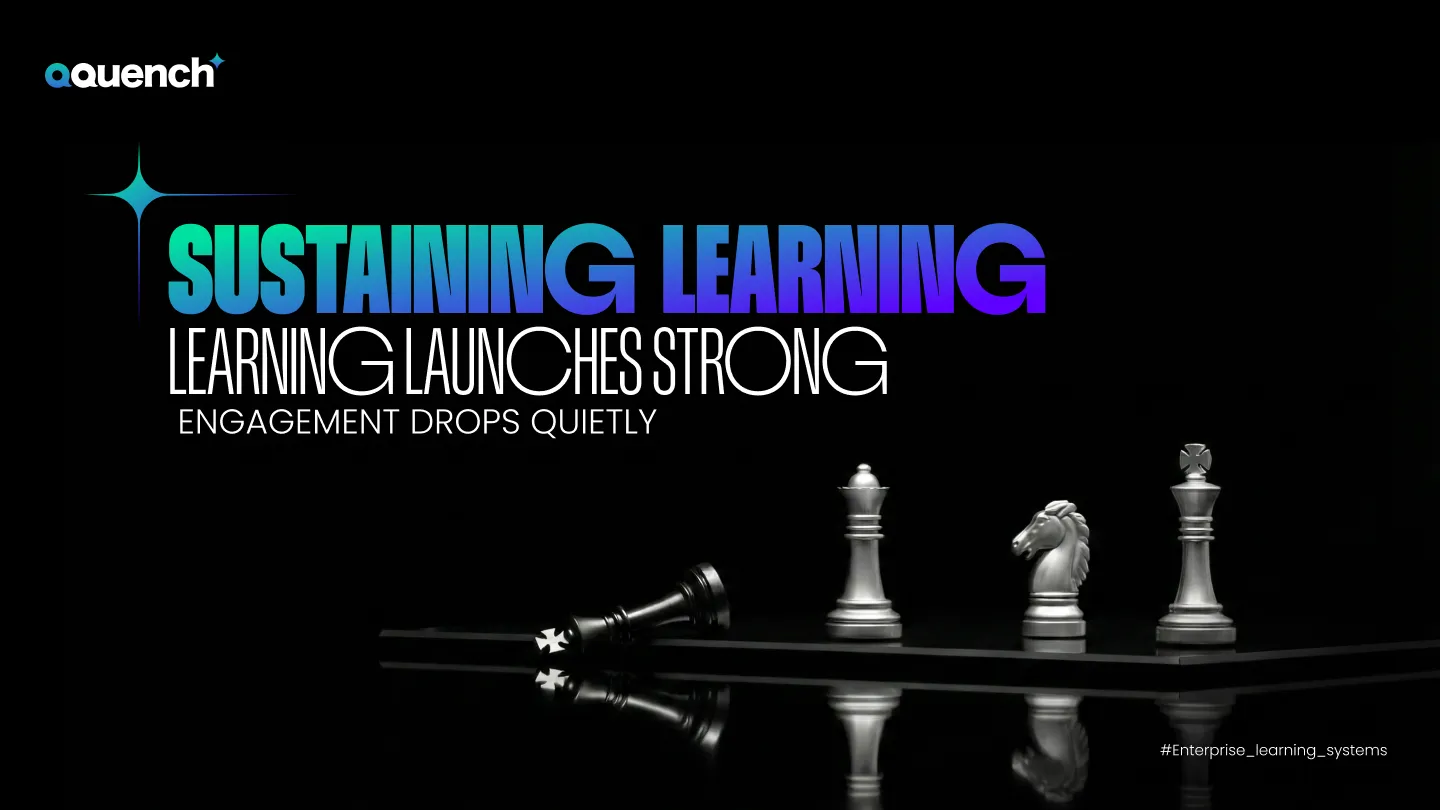
The Illusion of a Successful Launch After Launch Enterprise learning launches are often celebrated. Campaigns run.Communications flow.Participation spikes. Then attention moves elsewhere. What remains is a system expected to sustain itself. As discussed in Why Adoption Drops After Enterprise Rollouts, early success masks structural weaknesses that appear only over time. In many organizations, launch momentum…
The Illusion of a Successful Launch After Launch
Enterprise learning launches are often celebrated.
Campaigns run.
Communications flow.
Participation spikes.
Then attention moves elsewhere.
What remains is a system expected to sustain itself.
As discussed in Why Adoption Drops After Enterprise Rollouts, early success masks structural weaknesses that appear only over time.
In many organizations, launch momentum is mistaken for sustained capability.
Learning Is Treated as an Event

Most learning initiatives are designed as:
- One-time rollouts
- Finite programs
- Static content releases
But learning is not an event.
It is an ongoing system that must adapt as:
- Roles evolve
- Context changes
- Pressure increases
When learning is structured as a project rather than a system, momentum naturally fades.
Gartner research confirms that learning initiatives fail when they are not designed for continuous reinforcement: Learn more.
Engagement Decays Without Reinforcement
Initial engagement is driven by:
- Novelty
- Mandates
- Communication pushes
Once these fade, engagement depends on:
- Usefulness
- Relevance
- Confidence support
Without reinforcement, learning becomes forgettable after launch.
Without repeated application and reminders, knowledge retention declines rapidly.
This decay pattern mirrors the engagement gap explored in Engagement Is Not Learning.
Nielsen Norman Group research shows that knowledge retention drops rapidly without spaced reinforcement: Learn more.
Ownership Disappears After Launch
Before launch:
- Stakeholders are active
- Decisions are visible
- Accountability is clear
After launch:
- Ownership diffuses
- Signals weaken
- Feedback loops break
No one notices the stall until performance issues surface.
When accountability dissolves after rollout, learning systems gradually lose momentum.
This explains why learning decay often goes undetected by leadership.
Metrics Do Not Signal Stall Early Enough
Post-launch dashboards often track:
- Completion
- Access
- Time spent
These metrics flatten quickly.
They do not reveal:
- Confidence erosion
- Workarounds
- Avoidance behavior
Surface metrics stabilize even when learning relevance is declining.
As discussed in One Rollout Cannot Serve Every Role, static metrics cannot detect gradual decay.
Sustaining Learning After Launch Requires System Design
Learning systems that sustain momentum after launch include:
- Reinforcement cycles
- Contextual refreshers
- Performance-linked signals
- Ownership clarity
Sustainable learning requires ongoing reinforcement rather than one-time delivery.
This is how enterprise learning systems remain alive after rollout.
Launch Is the Beginning, Not the End
A strong launch is valuable.
It is not proof of success.
Learning succeeds when capability remains strong long after launch, when the noise fades.
Explore Further:
- Why Adoption Drops After Enterprise Rollouts
- Engagement Is Not Learning
- One Rollout Cannot Serve Every Role
- Content Delivery vs Capability Design
- Qquench Enterprise eLearning Solutions
- Learning Experience Design at Qquench
Design Learning That Lasts After Launch
Talk to Qquench about building learning systems designed for sustained capability, not short-term engagement.
FAQ: After Launch Learning Stall
Why does learning stall after launch?
Because most learning initiatives are designed as events, not sustained systems.
How can learning momentum be sustained?
Through reinforcement, relevance, ownership, and performance-linked signals.
Do high launch metrics indicate long-term success?
No. Early engagement often masks later decay.
What should CLOs monitor after launch?
Behavior consistency, confidence signals, and system usage in real work.