






Designing a Gamified Climate & Water EducationFacilitation Module for Teachers
Project Snapshot
| Industry | Global Education & Climate Learning |
| Geography | School-Based Learning Contexts |
| Audience | Junior Primary & Lower Secondary Teachers |
| Delivery Format | • Articulate Storyline (Interactive Version – SCORM) • Rise 360 (Fully Responsive Version with Embedded Activity Block) |
| Modules Delivered | 25–30 Minutes |
| Interactivity Level | Gamified Facilitation-Based Microlearning |
| Engagement Model | Demonstration Module Developed Alongside Proposal |
Impact at a Glance
Teacher -facing climate education module
Classroom facilitation prompts embedded throughout
Gamified “Saving Water Together” activity with animated feedback
Dual-format delivery (Storyline + Rise)
Fully responsive and LMS-ready
Age-appropriate instructional scaffolding
The Strategic Context
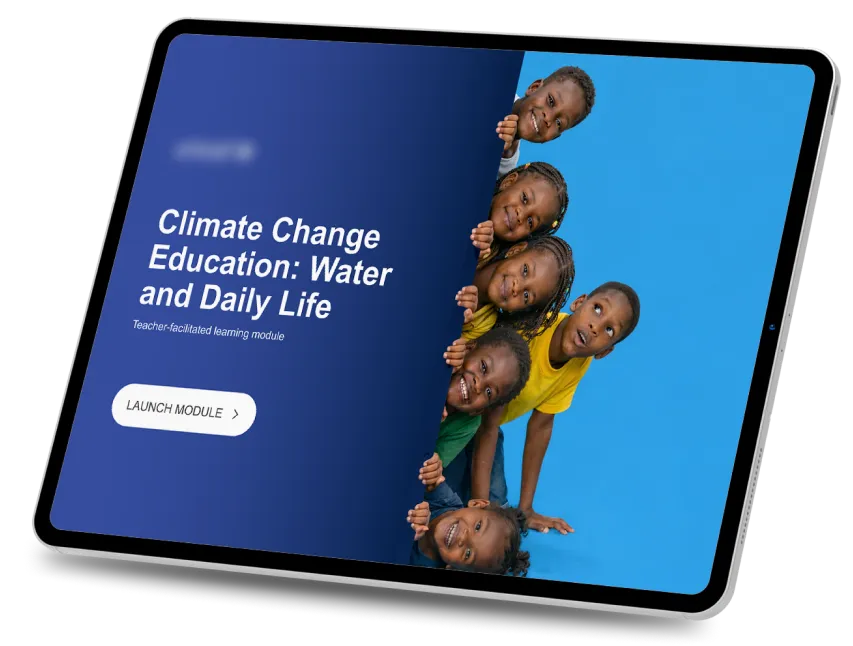
The agency required a demonstration module showcasing how climate and water education could be translated into practical, classroom-ready teacher guidance.
The objective was to:
Equip teachers with age-appropriate language to explain climate change
Help teachers connect climate concepts to daily water use
Provide facilitation prompts embedded with in the module
Encourage interactive classroom discussions rather than passive teaching
The module focused on water as an accessible entry point to climate education.

This demonstration was developed alongside the RFP proposal to showcase both instructional depth and technical capability.
Key Challenges & Constraints
1. Teacher-Centred
Design
The module was not student-facing. It needed to empower teachers with facilitation techniques.
2. Age-Appropriate
Framing
Content had to be simplified for Junior Primary learners without oversimplifying climate concepts.
3. Engagement in a
Short Format
The module was 25–30 minutes but required meaningful interactivity.
4. Dual-Platform Requirement
The solution needed to work both as a Storyline SCORM module and as a fully responsive Rise course.

Our Strategic Approach
Instructional Governance
Facilitation-First Design
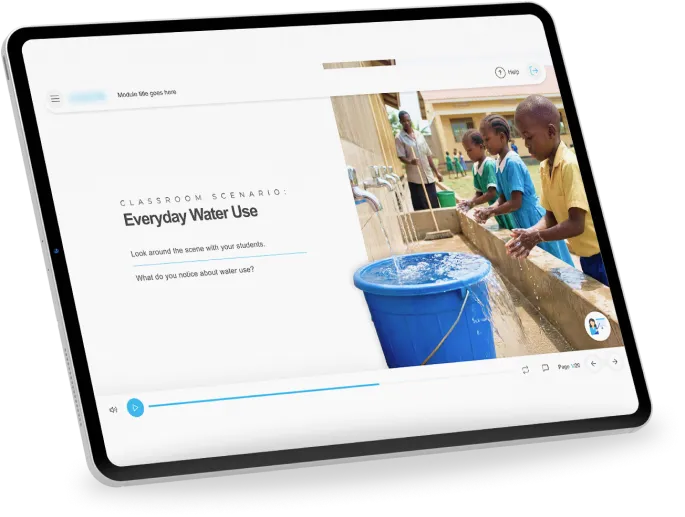
- Embedded teacher prompts such as “Ask your students…”
- Included structured discussion guidance
- Reinforced reasoning over speed
Climate Content
Simplification
- Broke down climate change into age-appropriate language
- Connected abstract concepts to water use behaviours
Gamified Activity
Architecture
- Designed an interactive roadmap-style activity
- Integrated three checkpoints with reflective questions
- Implemented animated bucket-filling feedback for correct responses
Dual-Format Development
- Built fully interactive Storyline module (SCORM-ready)
- Exported the interactive activity block into Rise
- Developed fully responsive Rise version for mobile compatibility
Experience Design Innovation
Teacher-Focused
Facilitation Prompts
Throughout the module, teachers were guided to:
- Pause and discuss
- Invite student reasoning
- Encourage explanation over speed
- Use climate examples grounded in water conservation
This transformed the module into a teaching companion rather than a content lecture.
Gamified “Saving Water Together” Activity
The interactive activity featured:
- A roadmap journey with three checkpoints
- Scenario-based water-saving decisions
- Visual reinforcement through bucket-filling animation
- Clear behavioural messaging tied to daily choices
Correct responses gradually filled a water bucket — symbolising collective impact.
This provided positive reinforcement without competition pressure.
Age-Appropriate Climate Scaffolding
The module simplified climate change into:
- Observable weather changes
- Everyday examples
- Relatable classroom discussions
Teachers were equipped to guide understanding in simple, clear language suitable for Junior Primary learners.
Dual-Format Deployment
To demonstrate scalability and accessibility:
- The Storyline version delivered advanced interactive logic
- The Rise version ensured full responsiveness
- Interactive activity blocks were exported from Storyline and embedded into Rise
This showcased technical flexibility within platform constraints.
Estimated Learning Metrics
(Based on Comparable Teacher-Focused Climate Education Deployments)

30–45% IMPROVEMENT IN TEACHER SELF-REPORTED READINESS
Facilitation confidence increase to conduct climate discussions
35–50% INCREASE IN
PARTICIPATION RATES
Engagement lift through gamified activity blocks in classroom contexts
25–40% IMPROVED
RECALL
Interactive learning improves concept retention compared to static teacher guides
85–95%
COMPLETION RATE
Completion benchmarks in short-format teacher enablement modules
Operational Execution timeline
phase 01
Climate Content
Structuring &
Storyboarding
phase 02
Gamified Activity
Design & Animation Logic
phase 03
Storyline
Development &
SCORM Packaging
phase 04
Rise Version
Adaptation & Activity
Embedding
The bucket-fill animation and dual-format integration represented the most technically sensitive components.
Impact Beyond Training
Strengthened Classroom Climate Dialogue
Teachers gained practical tools to facilitate meaningful discussions.
Increased Student Engagement Potential
Gamified structure encouraged participatory learning.
Practical Climate Behaviour Framing
Water conservation became a relatable entry point for climate action.
Platform-Ready Scalability
Dual-format build supports diverse device and bandwidth environments.
Key Takeaways
Facilitation Over Information
Teachers were equipped with discussion prompts, not just climate content.
Climate Linked to Daily Water Use
Water conservation became a relatable entry point for climate understanding.
Gamification Encourages Participation
The bucket-fill activity reinforced collective action
without competition.
Age-Appropriate Scaffolding Matters
Content was simplified without diluting scientific accuracy.
Dual-Format Ensures Accessibility
Storyline enabled interaction depth, while Rise ensured mobile responsiveness.
Short Modules Can Drive Readiness
Structured microlearning strengthened teacher confidence within 30 minutes.
FAQS
Q1. Was this module student-facing?
No. The module was designed for teachers to facilitate classroom climate discussions.
Q2. Did it include interactive activities?
Yes. A roadmap-style gamified activity with animated feedback reinforced water-saving concepts.
Q3. Was it fully responsive?
Yes. A Rise version was created for mobile accessibility, with interactive elements embedded from Storyline.
Q4. Was this a full programme or demonstration?
This was a demonstration module developed alongside the RFP proposal to showcase instructional and technical capability.
Q5. Was it LMS compatible?
Yes. The Storyline version was packaged as SCORM.
Through this demonstration, Qquench showcased how climate education for schools can move beyond informational slides into interactive, facilitation-driven digital learning — equipping teachers with the tools to make climate conversations meaningful, age-appropriate, and action-oriented.