





Designing aScenario-Based Water Quality & Public Health Training Module
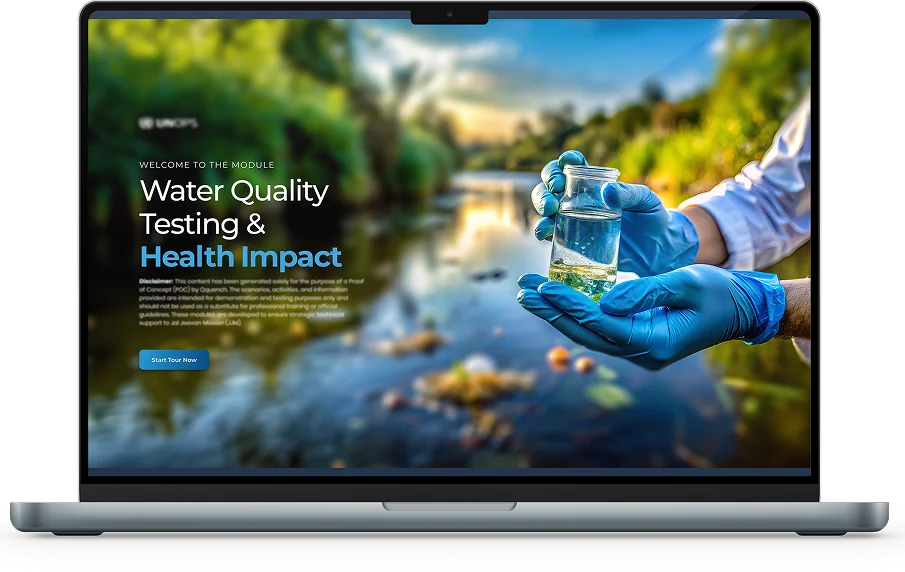
Project Snapshot
| Industry | Public Health & Rural Water Infrastructure |
| Geography | India (Jal Jeevan Mission Context) |
| Audience | • Village Water & Sanitation Committee (VWSC) Members • Field Technicians • Community Volunteers • Public Health Workers |
| Delivery Format | Articulate Storyline |
| Module Type | Proof of Concept (RFP Submission) |
| Focus Topic | Water Quality Testing & Health Impact |
| Estimated Seat Time | 15–20 Minutes |
| Interactivity Level | Advanced |
Impact at a Glance
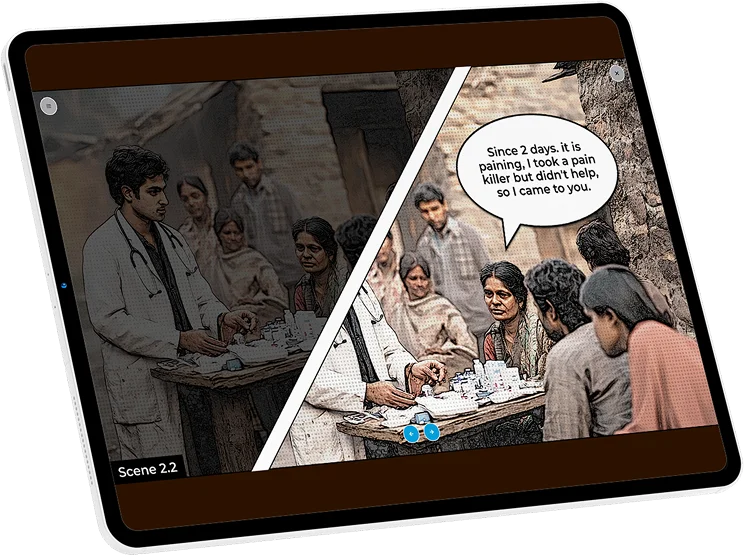
Emotional narrative-driven introduction video
Drag-and-drop procedural testing simulation
Hotspot-based exploration
Knowledge Checks embedded throughout
Immediate vs Long-Term Action Matrix
Designed to strengthen field-level technical competency
The Strategic Context
Under Jal Jeevan Mission (JJM), safe drinking water access and community-led monitoring are critical to rural health outcomes.
The objective of this Proof of Concept was to demonstrate how:
Technical water testing procedures
Public health awareness
Community responsibility
Preventive action planning
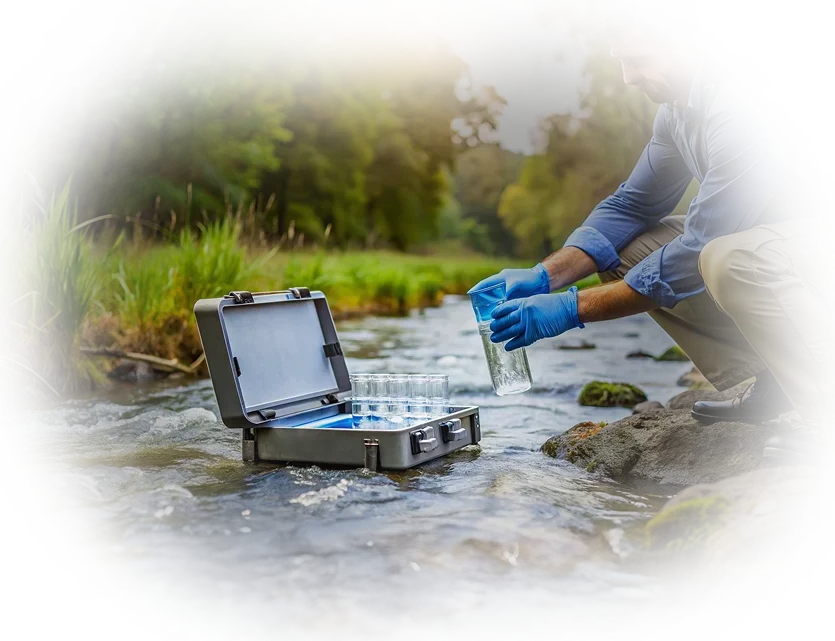
Could be translated into a scalable digital learning experience for rural stakeholders.
This was not merely procedural instruction.
It was about connecting water quality testing to health impact and community accountability.
Key Challenges & Constraints
1. Diverse Learner Profiles
The module needed to serve a mixed audience including:
- Technical field workers
- Community committee members
- Public health volunteers
Content had to be technically accurate yet accessible.
2. Translating Physical Procedure into Digital Simulation
Water testing is hands-on.
The digital format needed to simulate procedural sequencing clearly.
3. Linking Technical Steps to Health Outcomes
Learners needed to understand not just “how” to test water — but “why it matters.”

Our Strategic Approach
Instructional Governance
Emotional
Context Setting
- The module opened with a narrative-driven video highlighting the health and community impact of unsafe water.
Procedural
Simulation Design
- A drag-and-drop activity allowed learners to sequence water testing steps correctly, reinforcing procedural accuracy.
Hotspot
Exploration
- Interactive hotspots enabled learners to examine tools, testing kits, and contextual cues before making decisions.
Embedded
Knowledge Checks
- Short, applied questions reinforced understanding of contaminants such as E. coli, nitrates, and turbidity.
Action-Oriented
Summary Matrix
- The module concluded with a structured Immediate vs Long-Term Solutions framework, linking field action to sustained infrastructure planning.
Experience Design Innovation
Emotional Framing
An introductory video positioned water not just as infrastructure — but as a public health lifeline.
This elevated motivation before technical instruction began.
Virtual Water Testing Simulation
Learners engaged in a step-based testing simulation where they:
- Selected tools
- Sequenced procedures
- Validated correct order
This reduced procedural ambiguity and strengthened field readiness.
Applied Exploration Through Hotspots
Hotspot interaction encouraged active engagement rather than passive reading, supporting tool familiarity and contextual awareness.
Immediate vs Long-Term Action Mapping
The summary framework helped learners differentiate between:
- Urgent corrective actions
- Sustainable infrastructure improvements
This reinforced community-level accountability beyond individual testing.
Estimated Learning Metrics
(Based on Comparable Public Health & Field Skill Simulation Deployments)
40–55% IMPROVEMENT IN ACCURACY
Improvement in correct step sequencing after simulation exposure, reflecting procedural accuracy improvement
30–45% IMPROVED RETENTION
Simulation-based training improves technical recall compared to static instructional formats, demonstrating retention lift
35–50% HIGHER COMPLETION
Higher completion rates among mixed technical audiences through interactive modules, reflecting engagement increase
25–40% INCREASE IN CONFIDENCE
Digital simulation improves learner confidence in performing real-world tasks, strengthening field application confidence
Operational Execution Timeline
phase 01
Mission Alignment & Content Structuring
phase 02
Video Conceptualisation & Production
phase 03
Simulation & Drag-and-Drop Development
phase 04
Hotspot Integration & SCORM Packaging
The procedural simulation logic required precision to ensure technical accuracy.
Impact Beyond Training
Strengthened Rural Public Health Awareness
Learners understood the direct connection between contaminated water and health outcomes.
Improved Field Readiness
Simulation-based sequencing reduced potential on-ground procedural errors.
Reinforced Community Accountability
Immediate and long-term action mapping encouraged shared responsibility within village systems.
Scalable Technical Enablement
The POC demonstrated how field-based procedural training can be digitised without compromising clarity.
Key Takeaways
Technical Skills Can Be Simulated Effectively
Procedural drag-and-drop simulation improves accuracy and retention.
Emotional Framing Increases Engagement
Public health storytelling strengthens motivation before instruction.
Digital Training Can Support Rural Infrastructure Missions
When built with clarity and mission alignment.
Applied Interaction Outperforms
Static Instruction
Simulation and hotspot exploration increase confidence and readiness.
FAQS
Q1. Was this a full programme rollout?
No. This was a Proof of Concept developed for an RFP submission.
Q2. Who was the target audience?
Village Water & Sanitation Committee members, field technicians, community volunteers, and public health workers.
Q3. Did it include practical simulation?
Yes. The module included drag-and-drop procedural sequencing, hotspot exploration, and applied Knowledge Checks.
Q4. Was it LMS-ready?
Yes. The module was developed in Storyline and packaged as SCORM.
Q5. Did it link testing to health impact?
Yes. The training connected procedural steps directly to public health implications and community action.
This project reflects how Qquench designs public health learning experiences that go beyond instruction — transforming mission objectives into immersive, simulation-based digital training that strengthens both technical skill and community responsibility.