





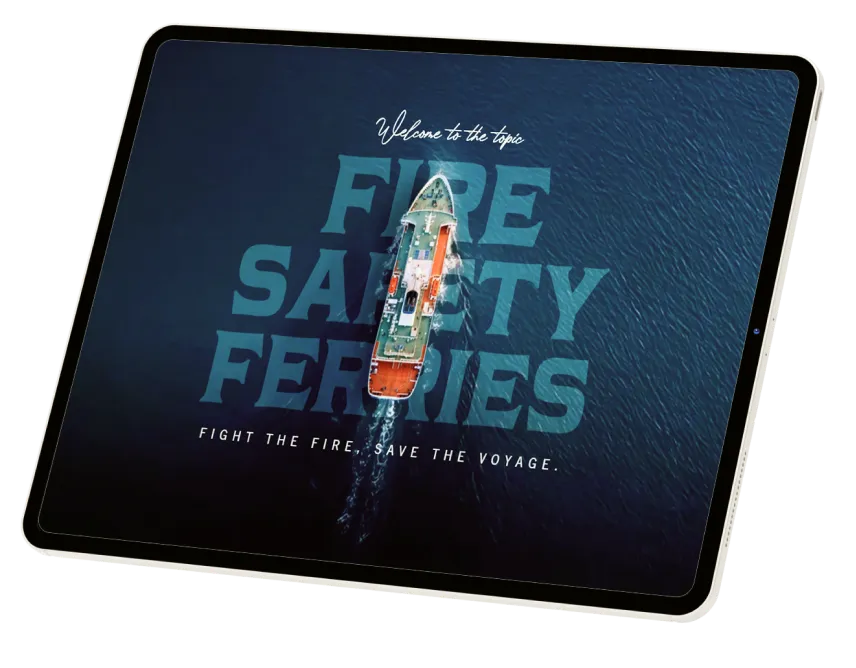
A Gamified
Fire Safety Ferries Simulation
for Maritime Crew Readiness
Project Snapshot
| Industry | Maritime Safety & Operations |
| Geography | Confidential Global Maritime Institution |
| Audience | Onboard Ship Personnel (Mixed Crew Roles) |
| Delivery Format | Storyline-based Gamified SCORM eLearning |
| Modules Delivered | 1 Interactive Simulation Module – level 4 |
| Total Estimated Seat Time | 45 Minutes |
| Languages | English |
| Project Duration | 4 Weeks |
Impact at a Glance
5 high-stakes emergency decision milestones
360° interactive vessel environment with hotspot-based simulations
Gamified scoring system with badge-based reinforcement
70% mastery threshold for safe-to-sail qualification
The Strategic Context
The institution required a high-impact fire safety programme to strengthen onboard emergency readiness, minimise operational risk, and reinforce life-saving behavioural response aligned with SOLAS standards.
The objective was not merely knowledge dissemination. It was behavioural activation. The programme needed to:
Reinforce rapid decision-making under pressure
Improve cross-role coordination during emergencies
Prevent avoidable fire-related incidents
Encourage ownership and proactive safety culture
Move beyond static compliance modules to immersive learning
This training was positioned as mandatory safety reinforcement designed to influence real-time onboard behaviour.
Key Challenges & Constraints
1. High-Stakes
Environment
Fire incidents at sea present life-threatening risks. The simulation needed to reflect urgency without overwhelming learners.
2. Behaviour
Over Theory
The focus was on action readiness, not theoretical fire classification alone.
3. Role-Based Coordination
Multiple onboard roles interact during emergencies. The module had to simulate interdependent decision-making.
4. Strict Institutional Branding
All design elements had to align with institutional guidelines while maintaining immersive realism.

Our Strategic Approach
Instructional Governance
The project followed a scenario-based mastery model aligned with Gagné’s instructional sequencing principles and competency-driven learning.
Analysis
- Identified critical fire response decision points onboard domestic ferries
- Defined behavioural competencies aligned with SOLAS expectations
Development
- Built in Articulate Storyline (SCORM compliant)
- Designed 360° panning vessel environments with interactive hotspots
- Embedded branching emergency decisions
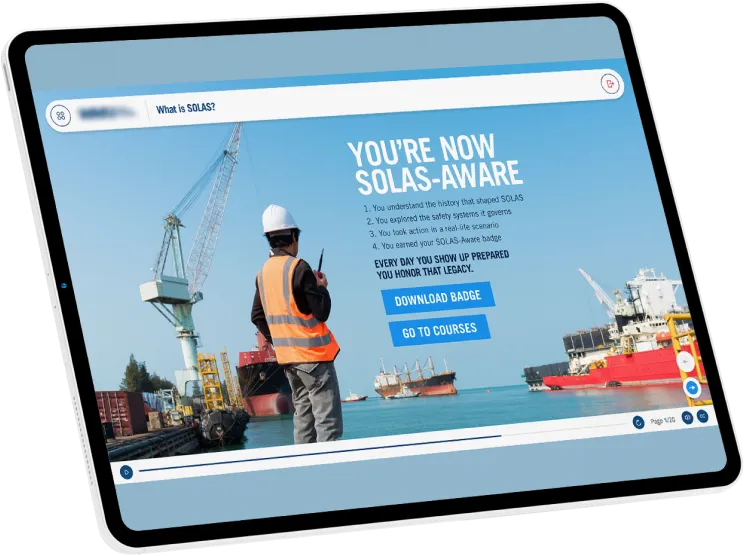
- Integrated badge-based gamification
- Included equipment handling simulations (extinguishers, hydrants, suppression systems)
Design
- Structured a five-milestone Fire Safety Challenge
- Developed a detailed storyboard (SB) outlining scenario logic, character dialogue, scoring flow, and hotspot interactions for client sign-off
- Integrated character-driven conversational decision-making
- Established scoring logic (10 / 5 / 0 system)
- Set 70% passing threshold to qualify as “Safe to Sail”
Review Cycles
- Iterative internal validation to ensure safety accuracy
- Compliance cross-check against SOLAS guidelines
Experience Design Innovation
The learning architecture moved beyond traditional linear safety modules.
Domestic Ferry Fire Safety Challenge
Learners progressed through five escalating decision milestones:
- Inspection — Galley
- Alarm — Bridge
- Controls — Power & Ventilation
- Media & PPE (Attack Strategy)
- Passenger Flow (Liaison & Coordination)
Each milestone included:
- Character-driven dialogue between four onboard roles
- Situational tension
- Interactive hotspot exploration
- Scored Knowledge Checks
After completing all five decisions, learners received a final “Safe” or “Unsafe to Sail” status before progressing.
360° Immersive
Hazard Simulation
High-resolution 360° ship environments allowed learners to:
- Pan across operational areas
- Identify potential ignition sources
- Select correct fire response equipment
- Evaluate ventilation and containment controls
This spatial simulation increased situational awareness and realism.
Gamified
Reinforcement
- Correct decision: 10 points + badge
- Medium-risk decision: 5 points
- Incorrect response: 0 points
- 70% required to pass
Gamification was used strategically to reinforce behavioural accountability without trivialising safety.
Estimated Learning Metrics
(Based on Comparable Maritime Safety Deployments)
90–95% PROJECTED COMPLETION RATE
Mandatory safety training benchmark
35–50% EMERGENCY RESPONSE KNOWLEDGE IMPROVEMENT
Increase in applied decision accuracy
25–40% BEHAVIOURAL READINESS IMPROVEMENT
Improvement in scenario-based response accuracy
30% RETENTION IMPACT
Immersive simulations demonstrate stronger procedural retention compared to static safety modules
Operational Risk Reduction Potential
Scenario-based maritime safety training is associated with measurable reduction in preventable incident rates in comparable deployments
Operational Execution Timeline
Week 01
Scenario Architecture + Game Logic Design
Week 02
360° Environment Build + Character Integration
Week 03
Full Simulation Development + Scoring System
Week 04
QA, SCORM Packaging, and Deployment Readiness
The accelerated 4-week timeline was achieved through structured milestone alignment and early scenario sign-off.
Impact Beyond Training
(Projected Safety Outcomes)
Stronger Emergency Coordination
Character-driven scenarios reinforced inter-role communication during crisis events.
Faster Hazard Recognition
360° simulations improved spatial awareness and early detection behaviours.
Behavioural
Ownership
Gamified accountability strengthened decision responsibility under pressure.
Culture of
Safety
The module reinforced a proactive safety mindset rather than reactive compliance.
Key Takeaways
Simulation Drives Preparedness
Immersive, scenario-based training better prepares maritime crews for real emergencies.
Behaviour Must Be Practised,
Not Memorised
Fire safety requires decision fluency
under pressure.
Gamification Can Reinforce Accountability
When applied responsibly, scoring mechanisms increase engagement and seriousness.
Regulatory Alignment Enhances Credibility
SOLAS-aligned training strengthens
institutional safety governance.
FAQS
Q1. Was this programme aligned with maritime regulations?
Yes. The learning scenarios were structured in alignment with SOLAS safety principles and onboard emergency expectations.
Q2. Was the training gamified?
Yes. A structured scoring system and badge reinforcement model were integrated to encourage behavioural accountability.
Q3. Did the module include immersive simulations?
Yes. Learners navigated 360° ship environments with interactive hotspots and branching decisions.
Q4. Was this mandatory training?
Yes. The programme supported institutional fire safety reinforcement objectives.
Q5. Can this simulation be adapted for other vessel types?
Yes. The scenario framework allows modification for different ship classes or operational contexts.
This project demonstrates how Qquench leverages immersive, gamified simulation to transform mandatory fire safety training into meaningful behavioural readiness, strengthening maritime safety culture where it matters most: at sea.